Use offline open weights.
j4k3
joined 2 years ago
It is the tiny URL link that has a unique identifier. The normal website links are just the regular website address root for reddit.com. Tiny URL links stand out more to me because I use a DNS whitelist firewall and will never approve any of these forwarding connections.
Why the reddit tracking link?
The easiest way I know of to check any machine is to put another router or machine in front of it with a white list firewall or way of logging DNS traffic. You just need to spot the address in the list.
DNS filtering usually only filters on incoming packets, but for bot stuff that should catch issues.
In general, most routers run everything from a serial flash chip on the board. These are usually 8, 16, or 32 megabytes. They have a simple bootloader like U-Boot. This is what loads the operating system. These devices have a UART serial port on the PCB. You can use a USB to serial UART adaptor to see what is happening in the device. With a proprietary OS, you are still likely to see the pre-init boot sequence that the bootloader prints to terminal. Most operating systems also print information to this interface, at least of the couple dozen junk devices I have been given and messed around with. I make a little mount for a USB to serial adaptor and add it to all of my routers when new, so I only need to plug in USB to get to the internal bootloader and tty terminal interface of OpenWRT. You will need to know the default baud rate of the device, although it is probably listed somewhere online or can be guessed as one of the common high values at or above 9600.
Getting into this further gets complicated. It is probably better to look for any CVE that is relevant to the device or software and work backwards. Look for any software updates that have obfuscated the risk for each CVE. If the issue was not fixed, that is where to look to see if someone has exploited the device. Ultimately, they need clock cycles from the CPU scheduler. So it must be a process or some way of executing code from unregistered memory.
This is getting to the edge of what I have messed around with and understand. There may be a way to get a memory map that includes unused pages, and compare that with a hex dump of the flash memory. This is outside of your scope of a proprietary OS, but hopefully frames the abstract scope of what is possible on this class of device when you have an open source stack. The main advantage of this kind of device and issue is that you can physically remove the flash chip and then see and manipulate every page and memory location. The device likely doesn't have microcode loaded into the CPU(s) that make it challenging to determine what is going on.
There is probably an easier way, but a hex dump of the current system can be hashed against the factory updated version to see if any differences are present. It is likely that any exploit will include a string with the address to connect to somewhere in flash memory. It could be obfuscated through encryption or a cypher, but a simple check for strings in the hex dump and a grep for "http" is a simple way to looks for issues.
The OpenWRT forum is a good general source. The people behind the bootloaders for these devices are also Linux kernel developers and on the OpenWRT forum.
A master wood machinist, if ever there was such a thing.
https://www.youtube.com/watch?v=TyTE0OaB4oM
I made a Crytex such as the one from Da Vinci Code, out of wood. This time I used aluminum as well as a metal lathe to produce parts that would have otherwise been too fragile for a customer.
Ebenisterieeloise.com
One of my favorite rare-to-upload stuff - channels. She likes a type of classical music that resonates with me, and I like the way she composes the content, music, and voiceover, combined with clever approaches to problem solving and projects.

This is a 2012 Lazer Helium cycling helmet. They came with this silicone gel pad. I had one of these and loved it. Lazer does not make/sell these any more after they were bought out by Shimano-America.
These pads were odd in how they were packaged originally and had no form of branding, hinting that they may have been sourced from some other industry or application. Search engines are garbage when I try to find the abstract application keyword for wherever these originated from due to advertising disinformation obliterating anything remotely useful. I imagine these may come from something like surgeons to prevent sweat contamination or for very hot environments like mines or foundry work. Does anyone know of applications where they have seen a pad like this sold or used?

The info wore off the grip and I do not recall what it was. I think it was a German brand. These have been one of my favorite tools for a decade. The jaws are much more narrow than what is typical for side cutters and these handle like a surgeon's scalpel. Best of all, they can be sharpened many many times. Unfortunately, these are getting close to end of life from all of my sharpening and pivot pin wear. I want to get another set, but I have never been able to figure out the brand to find them again. They were given to me by a tech for a computerized Guru bicycle fit machine we had installed in one of our bike shops in 2012.

1
Old TV loudspeaker, what is the deal with the encapsulated driver magnet and zigzag port?
(lemmy.world)
The magnet is around an order of magnitude more powerful on the coil side versus the back, so must be Eddie/Maxwell magic mathsticism of some wizard variety. Are these style drivers typically rare earth magnets? The sticking power feels like a rare earth magnet, but I don't know that factually is the case. Perhaps the flux is unintuitive when guided well.
Is the port shape intended to increase the Reynolds coefficient... (Is that even a valid question at this limited displacement volume? Like, I don't even know how, or if, this falls between laminar and turbulent regimes, or if such a system should be modeled more like a spring and damper or something like that.) Do you think the little square volume in the lower left is intentional or a byproduct? Does this port design have a niche name specific to the zigzag?


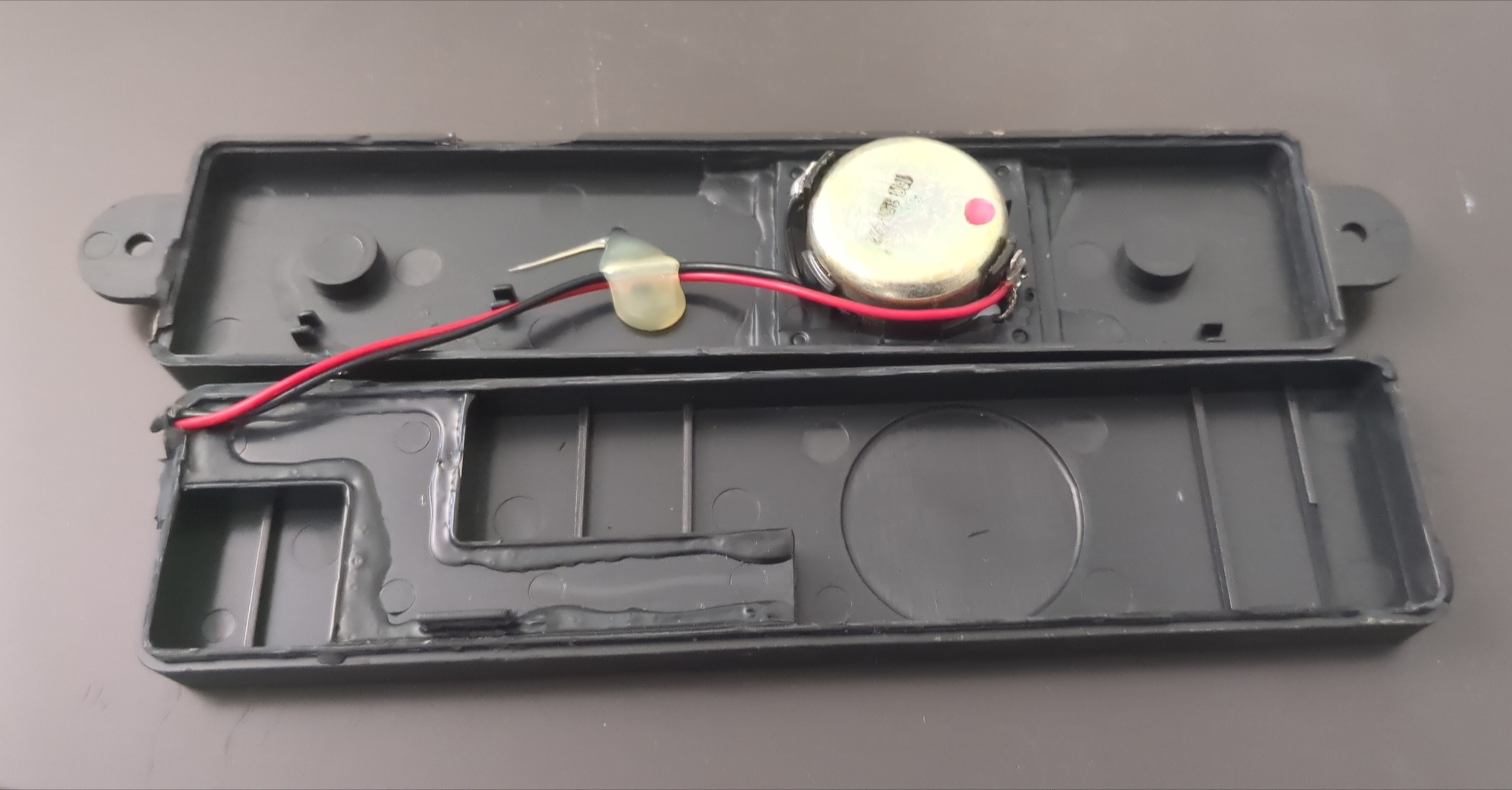
You can see the outside on the edge of the top speaker (bottom-right corner). The wood is thin, maybe 2mm, and glue applied likely by a machine, yet the slot length looks like it was intended for tuning frequency response. But why wood, and only for this one side of the one slot in an otherwise plastic housing?

1
What type of hose is used in cheap consumer products (like a clothing iron in this instance)?
(lemmy.world)
It is more flexible in tight spaces without collapsing. The color and texture remind me of RTV gasket making silicone in automotive applications, but these (very old) tubes do not have any hint of the pungent oder of RTV gasket maker, or anything else for that matter.
I'm looking for a hose that is more flexible than typical rubber (like automotive) and PVC (gardening/aquariums) hose in a 1/4in or 6mm ID for ethylene glycol at pressures between 1 & 2 bar and at 30-100 C. I need to turn around a 50mm radius reliably with flexibility and without substantial (~15%+) constriction... If any experts are around – TIA

Sure