You Should Know

42465 readers
457 users here now

YSK - for all the things that can make your life easier!

The rules for posting and commenting, besides the rules defined here for lemmy.world, are as follows:

Rules (interactive)


Rule 1- All posts must begin with YSK.

All posts must begin with YSK. If you're a Mastodon user, then include YSK after @youshouldknow. This is a community to share tips and tricks that will help you improve your life.


Rule 2- Your post body text must include the reason "Why" YSK:

**In your post's text body, you must include the reason "Why" YSK: It’s helpful for readability, and informs readers about the importance of the content. **


Rule 3- Do not seek mental, medical and professional help here.

Do not seek mental, medical and professional help here. Breaking this rule will not get you or your post removed, but it will put you at risk, and possibly in danger.


Rule 4- No self promotion or upvote-farming of any kind.

That's it.


Rule 5- No baiting or sealioning or promoting an agenda.

Posts and comments which, instead of being of an innocuous nature, are specifically intended (based on reports and in the opinion of our crack moderation team) to bait users into ideological wars on charged political topics will be removed and the authors warned - or banned - depending on severity.


Rule 6- Regarding non-YSK posts.

Provided it is about the community itself, you may post non-YSK posts using the [META] tag on your post title.


Rule 7- You can't harass or disturb other members.

If you harass or discriminate against any individual member, you will be removed.

If you are a member, sympathizer or a resemblant of a movement that is known to largely hate, mock, discriminate against, and/or want to take lives of a group of people and you were provably vocal about your hate, then you will be banned on sight.

For further explanation, clarification and feedback about this rule, you may follow this link.


Rule 8- All comments should try to stay relevant to their parent content.


Rule 9- Reposts from other platforms are not allowed.

Let everyone have their own content.


Rule 10- The majority of bots aren't allowed to participate here.

Unless included in our Whitelist for Bots, your bot will not be allowed to participate in this community. To have your bot whitelisted, please contact the moderators for a short review.


Rule 11- Posts must actually be true: Disiniformation, trolling, and being misleading will not be tolerated. Repeated or egregious attempts will earn you a ban. This also applies to filing reports: If you continually file false reports YOU WILL BE BANNED! We can see who reports what, and shenanigans will not be tolerated. We are not here to ban people who said something you don't like.

If you file a report, include what specific rule is being violated and how.


Partnered Communities:

You can view our partnered communities list by following this link. To partner with our community and be included, you are free to message the moderators or comment on a pinned post.

Community Moderation

For inquiry on becoming a moderator of this community, you may comment on the pinned post of the time, or simply shoot a message to the current moderators.

Credits

Our icon(masterpiece) was made by @clen15!

founded 2 years ago
MODERATORS
1


Participants were measurably happier and less anxious.

But disappointingly, not by a huge margin:

Perhaps this is due to the fact a significant number of users switched to less harmful online platforms and didn't stop using their phones.

Or perhaps there is actually something more sinister. My real concern with this study is the involvement of Meta.

We actually have evidence that Meta halted internal research about social media:

https://www.reuters.com/sustainability/boards-policy-regulation/meta-buried-causal-evidence-social-media-harm-us-court-filings-allege-2025-11-23/

Would you study tobacco and have tobacco companies involved?

Would you study obesity and have Coca-Cola involved?

I don't want to sound like a conspiracy theorist, but could Meta actually bully/bribe Stanford in order to change the figures?

2


New Orleans unsolved is a podcast that began in 2020 examining the unsolved murder of a young boy, Eddie Wells, in the Bywater neighborhood of New Orleans during the 1980s. Eddie's life was full of hardships, and when his body was pulled from the Mississippi river, he was depicted as a "hustler," or male prostitute in the French Quarter, despite only being 17 years old at the time of his death. However, the term "hustler," downplays the reality that Eddie was a victim of sexual abuse and sex trafficking starting at an early age.

What began as a podcast about one unsolved case soon turned into a podcast about several similar cases which could all be linked back to one man, former NOPD child abuse detective, Stanley Burkhardt.

https://www.theguardian.com/us-news/2025/sep/04/new-orleans-stanley-burkhardt-bail-reduction-denied

https://www.scsaorg.org/stanley_burkhardt

https://www.wwltv.com/article/news/investigations/losing-faith/ex-nopd-child-abuse-detective-himself-a-serial-molester-confronted-by-wwl-guardian/289-5c0ca0d6-605c-4da1-afed-6e278b5a6760

https://www.fox8live.com/2025/08/06/former-nopd-detective-convicted-sex-offender-back-jail-facing-new-charges/

https://www.nola.com/news/courts/disgraced-new-orleans-police-detective-long-deemed-sexually-dangerous-gains-release/article_a64de55a-f8fb-11ee-b201-c39f3048b0f6.html

Recently, stories about the payouts to survivors of sexual abuse by the New Orleans Archdiocese, and documentaries, such as Scout's Honor, have touch on some of the overlap between victims of these child abuse networks. However, their connection to Burkhardt, as well as many of the details uncovered by the podcast have received frustratingly little attention.

Despite the clear danger of doing so, Burkhardt was released from prison in 2024, and recently re-arrested for once again violating his parole this past summer. To my own horror, despite listening to this podcast for the past few years, and following updates about Burkhardt, I learned after the fact, that before he was re-arrested, Burkhardt had been working at the local grocery store in my neighborhood.

Had I known this, I definitely would have taken more precautions considering my own child frequently visited the store while he was working there. However, it turns out when Burkhardt's own coworkers were asked if they had been informed about his dangerous history with children and his abuse of his position of authority, even they were completely unaware.

The podcast has been self-funded by the host and donations from listeners throughout its entirety, and somehow, despite all the evidence uncovered by local journalists and the host of the podcast, as well as the wild twists and turns she's discovered while investigating these murders, such as the undeniable overlap between the plot of the TV show True Detective and several cases related to Burkhardt, (It turns out, in addition to being a narcissist and a pedophile, writings left behind in Burkhardt's prison cell after his release in 2024, indicated he also enjoyed writing "fiction." However, in his fictionalized version of events, the detective was usually the hero who made the big break and saved the day.), it remains relatively unknown.

It's a bit convoluted trying to re-explain how eerily so many details behind decades of forgotten cold cases line up with a "fictional" TV show that aired years ago, but I highly recommend listening to this podcast (as a warning, some of the content is very graphic and very upsetting to hear). Much of the information uncovered has been added the long list of evidence against Burkhardt, but it still continues to receive very little attention, even at a local or state level. However, it's important to note, even when these crimes were being actively committed, many attempts to seek justice by survivors of Burkhardt's abuse and family members of the deceased victims, led to dismissal by authorities (often due to stigma at the time regarding sexual abuse and rumors which may have intentionally been spread about the lifestyles of the murder victims), missing evidence, and several other mysterious dead ends.

To give you an example of how unknown this podcast and the very serious charges against Burkhardt have somehow remained even at the most local level, I mentioned it while getting a haircut a few months ago when Burkhardt was most recently re-arrested. The lady cutting my hair had never heard of the podcast, or the connection between the murders, but she had grown up in the same neighborhood outside of the French Quarter, and actually knew Stanley Burkhardt when he was a detective working the Quarter.

That's just to say, please feel free to share the podcast, and information about these murders and Stanley Burkhardt, wherever you feel is appropriate. The victims and their families deserve justice. Even if Burkhardt is finally locked away for good this time, and unable to hurt anymore children, there seems to be no reason to believe that all the powerful networks he was involved with ever stopped commiting crimes. More likely they've just gotten better at hiding in plain sight.

3
4


The government targeted disabled people from some of the poorest communities in the country, who McNamara referred to as, "the subterranean poor."

Many of those drafted were illiterate, they had to be taught to tie their shoes, and they didn't know things like who the president was, even as they were being sent to kill and die on his orders for an imperialist war, for reasons they could not understand.

A book called McNamera's Folly records some stories of those recruited in the program. One thought a nickel was worth more than a dime, because it was bigger. One of them failed to attend training and was sentenced to four years of labor in prison, and the sergeant asked if anyone "wanted to join them in the stockade." Another conscript didn't know what the word "stockade" meant and thought it meant going home, so he said yes - he received the same sentence.

If you can believe it, this was actually sold to the public as a "progressive" program, as part of Johnson's "War on Poverty." The claim was that this would be a way to help the conscripts learn useful skills. in reality, a study by the DoD itself found:

Comparisons between Project 100,000 participants and their non-veteran peers showed that, in terms of employment status, educational achievement, and income, non-veterans appeared better off. Veterans were more likely to be unemployed and to have a significantly lower level of education. Income differences ranged from $5,000 [to] $7,000 in favor of non-veterans. Veterans were more likely to have been divorced.

Obviously.

5


The Haganah commanders acted against experts’ advice and placed the bomb in the rickety side of the old ship, rather than under the machines area, where there would be no passengers. The Patria disaster was largest catastrophe in which Jews caused the death of other Jews.

6


What’s with all the brand new accounts that post random YSKs then delete their profile? There are a lot of these in YSK and I can’t figure out why.

7


In addition to not tracking you and being fully open-source, there are 12 search categories in its settings with literally hundreds of available search engines.

8
1
submitted 2 weeks ago* (last edited 2 weeks ago) by Artisian@lemmy.world to c/youshouldknow@lemmy.world


YSK: there was a time when pumpkin pie was comparitively niche as fall holiday foods go. People would make sweet potatoe pie. However, it was essentially impossible to source sweet potatoes in the USA that were not made via slave labor, and so abolitionists pushed for an alternative: pumpkin pie. It's interesting what boycotts and politics are baked into culture (and ovens), and how we forget about their origins.

9


Anki is an open-source flashcard app for Windows, Linux, Mac OSX with versions also available for Android and iOS. Unfortunately, iOS version costs $25, but all other versions are free.

Anki is a self-graded flashcard program / app. This makes it a combination quiz-app + timer system. Unlike Duolingo or other programs, Anki entirely relies upon self-grading, but this is more than sufficient for study.

Anki grabs the top cards from a deck (defaulting to 20 new cards per day. Feel free to customize this to whatever fits your needs best). Then each day, it grabs "scheduled review" cards + shuffles in the new cards, and shows you them one at a time. Once a card is shown to you, you the user click a button to reveal the other side.

After the flip, Anki asks you to self-grade yourself on your performance. "Again" means you grade yourself as "incorrect", and Anki will remember this mistake. Because you were "incorrect" on this card, Anki will show you the card again very soon.
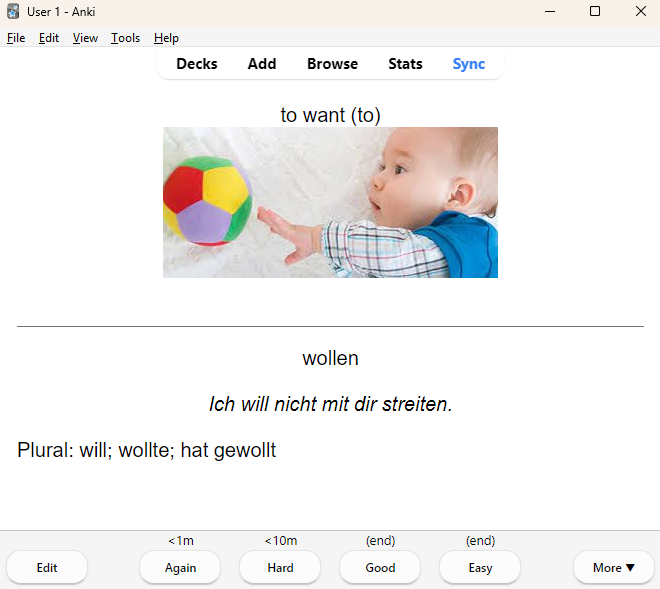
If you choose one of the three "correct" scores (labeled "Hard", "Good" and "Easy"), Anki remembers that you've answered correctly, and will schedule the card some time in the future. I'll get to the difference of the three scores later, but consider all three to just be "correct" for now.

The precise time is calculated based on how well Anki thinks you know the card. If you know the card well, "Good" might schedule the card to be reviewed 1 month from now, but if you've made a lot of mistakes with a particular card, then that card will likely be reviewed 1 or 2 days from now. Its all data collected on a per-card basis.
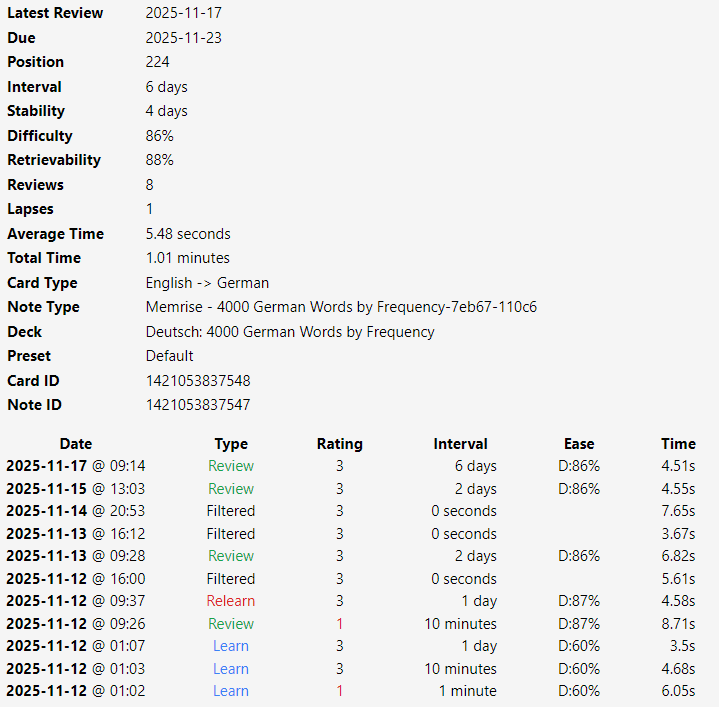
Above is an example screenshot of Anki's memory: every single self-graded score is remembered on every single card, as well as the date and time of each score.

As such, Anki is a system of spaced repetition. The "better" you are with some cards, the less you see them. The "worse" you are with other cards, the more Anki shows you those particular cards you keep making mistakes with. Timer + self-grading == you only see the cards you're doing bad with, while Anki hides the cards you are doing good with.

The Algorithm

FSRS is a new experimental algorithm Anki is using. There's been 6 versions (FSRS-1, -2, -3,... and of course FSRS 6 today). Fortunately, the overall gist has been the same for all 6 versions. Alas, its a lot of blogposts and technical math that's far too nerdy for most people https://github.com/open-spaced-repetition/fsrs4anki/wiki/The-Algorithm. For the math nerds who want to learn the algorithm, study away. But I'll attempt to do a simpler "translation".

Before we get started, click on your deck's preferences and scroll down to the FSRS button. Ensure it is on.

FSRS is simply three pieces of memory being applied to each and every "card" in your Anki decks. Every single card will try to figure out "R", "S" and "D". R is the probability that you've forgotten a card each day. The longer a card goes without being shown, the worse-and-worse "R" gets (this is the value Anki uses to determine when to repeat a card to you, it wants to show you a card before you've forgotten, but after enough time that you had a chance to forget, defaulting to 10% chance of forgetting).

Every single card tracked by Anki has this "forgetting" curve, primarily defined by the "R" aka Retention variable.

The theory is: if you show a card too often, you never really test your long-term memory. Furthermore, its too much extra work to review so many cards. By waiting days, weeks, or months before showing you a card again, Anki saves you time by not overly-reviewing cards you already know the information of. Furthermore, studies have shown that showing you information "right as you are forgetting about it" is the best way to remember (!!!). Any sooner, and you really aren't learning too well, but instead just temporarily holding things in your short-term or medium-term memory.

"S" stands for Stability. The more "stable" a card is, the longer Anki-FSRS thinks it can stay in your memory memory without review. Most "new" cards are assumed to be forgotten about within a day by default. However, as you get the card "correct" over-and-over again, Anki-FSRS will increase stability, thereby causing the longer review intervals. (Maybe showing you a card once every 3 days, then 7 days, then 1.5 months, then 3 months....).

"D" stands for Difficulty. The more times you get a card wrong (ie: when you click the "Again" button), the worse Difficulty gets. Anki-FSRS remembers that some cards are harder for you to remember... in particular the ones you keep getting wrong.

Even if you get a high-difficulty card correct multiple times, Anki "remembers" that you have been forgetting this card, and will show it to you again sooner. Ex: by default Anki will mature a card within 7x correct answers in a row. However, if a card is "difficult", Anki will keep showing you that card 10x, 15x or more, knowing that you need the extra practice.

Or in more math-nerd terms, "Difficulty" is the derivative of stability. The change-of-stability is determined by the "Difficulty" of a card.

Hard / Good / Easy

Hard / Good / Easy all count as correct (ie: increases the stability of Anki-FSRS), but will do different things to your Difficulty score.

"Good" is the default, and Anki recommends that users hit the "Good" button 80%+ of the time. Lets pretend that a particular "Good" answer will result in 1-month timer for a particular card...

"Easy" basically is telling Anki that you don't want to practice with this card anymore (ie: low-difficulty card). After clicking "Easy", instead of taking a 1-month timer... Anki will likely choose a 1.5-month or 2-month timer on the card.

"Hard" is telling Anki that you want extra practice with this card. It increases difficulty, despite increasing stability. You'll see this card again more-and-more in the future. Instead of 1-month timer, Anki might show you the card again within 2-weeks.

Where Anki fits in language learning

Anki was originally developed to help its original programmer learn Japanese. Its not an end-all be-all app however. Anki is only a piece of any language-learner. You must also buy grammar / theory books, as well as write regularly in the new language... speaking and listening and more.

Nonetheless, "Anki" is your cudgel. A brute-force method to try to force vocabulary words into your brain through raw force. You'll likely never gain mastery of the words through Anki... but you can at least become a beginner and learn how to start reading. There's literally thousands, if not tens-of-thousands of words you must learn to become proficient in a language. And that's spelling, grammar usage (gender / der/das/die in German, or maybe conjugation rules and pluralization rules), definitions and more!!

In all cases, Anki can be used as a way to force this information into your brain, getting it ready so that those words can "begin to be learned" when you watch TV, listen to a foreign language podcast or hear those words in a song.

Yes, Anki isn't enough. But Anki is a great tool to get you started. And getting started is sometimes the hardest step for many people.

Remember: 1000 words is beginner level (near 1st grade level understanding), while 10,000 words is roughly high school level. If you wish to be seen as a competent adult in a new language, you must figure out a system to reach those 10,000+ words known. 10,000 words sounds like a lot in isolation... especially because true mastery of 10,000 words includes spelling, grammar (pluralization/conjugation/gender), meaning, and pronunciation. But think about it: 10,000 words is merely 14 words per day for 2-years. Plenty of people have used Anki to jumpstart that kind of long-term forced-learning of words.

My Anki routine

My current Anki deck is the 4000 German words/phrases by frequency (https://ankiweb.net/shared/info/653061995). Anki decks vary in quality but this is one of the better German decks.

Despite that, this deck starts out-of-order. I had to reorder the first 200 words into the correct order (for some reason, words #1 through #200 were actually the least frequent words). After reordering, I hit the "FSRS" button, signed up to AnkiWeb.com and synchronized my Desktop + Phone to this deck through the web-account.

I currently keep the defaults of Anki-FSRS at 90% retention and 20 words per day. I roughly have 80 review words per day + 20 new words, or 100 flashcards to review (front and back). I hit "good" or "again" most often, though some very easy words (ex: "Ich") I do hit the "easy" button on. I rarely hit "hard" at all.

When a card feels poorly made, I always go into "Edit" and improve the card. In most cases, the "English side" of this deck is lacking (ex: "because" either turns into weil or denn). In these cases, I add a German sentence to the English side with the German-word missing, so that the card can become "more fair" as study material. Anki Decks should always be customized to become your own notes.

If Anki gives me a new word, I also check Wiktionary for the proper pronounciation, as well as additional "example sentences" of that word. Anki is NOT a dictionary, its simply a notecard system, and you should rely upon good and proper dictionaries. In some rare cases, I go to German Language Discord and ask the community to help me understand a concept, but in most cases I do try to figure out the word myself.

I also use many songs, kids songs, Anime songs, pop songs and more as my primary source of "Practical German". (Ideally songs harder than Ramstein's "Du Hast", lol). I'm building an Anki deck out of these songs (ex: Backe Backe Kuchen, or "Bake Bake a Cake", a traditional German kid's song, has a list of common ingredients like sugar, salt, milk. Its good vocabulary practice... and also is a good source of practical words for an Anki deck). I also have a beginner German book ("Cafe in Berlin"), with a huge vocabulary list. Fortunately, the author for this book already made an Anki deck and I can just go to to the listed website and download the pre-made Anki.

10
11
12


An alternate calendar system briefly used by republican France. It had 360 days per year with 5 or 6 "intercalary" or leap days between years. It had 12 months of 30 days, which were comprised by 3 weeks of 10 days. Every day of the year had a unique name: a common plant, animal, mineral, or tool/equipment (ie January 31 was "Broccoli" and May 4 was "Silkworm").

YSK because it's an interesting alternative to the Gregorian calendar and the occasionally-proposed 13 month calendar.

Though it did have some problems such as starting in late September (very unusual for a calendar) and not having a robust leap-year system.

13


Step 1: Boil a pot of water to a full boil, it should take about 8-9 minutes

Step 2: Use a spoon to put the eggs in one at a time, but hover each one just above the water for about 5 seconds before gently putting it in. This prevents the shells from cracking due to shock of the hot water.

Step 3: Set a timer for 8:30-9:00

Step 4: While the eggs are cooking, get a bowl filed with ice water

Step 5: When timer goes off, put the eggs but not the hot water in the ice water. Let them sit for about 45 seconds. This step will make sure the egg shells peel off of the egg without sticking

Step 6: Remove the eggs from the ice water. I like to do this before they cool down much, so they are still warm when I eat them.

I've looked at dozens of articles online that don't work. This combines two methods and adds some improvements. If you put the eggs in and then bring the water to a boil the shells stick when you try to peel them. If you don't hover the egg over the hot water for a few seconds some eggs will crack and raw egg fills the water. If you don't put the eggs in ice water they will be tough to peel. I like to eat boiled eggs with salt and pepper and I put mustard on the side of the plate to dip them in, tastes like a deviled egg.

enjoy

14


Why YSK: Because in this economy, "free" is the best four-letter word. Seriously, it's wild how many people don't realize their public library card gives them access to a treasure trove of digital content. We're talking apps like Libby, Kanopy, and Hoopla, which means free movies, documentaries, e-books, and audiobooks. You just need that little piece of plastic (or the digital equivalent). Think of all those subscription fees you could avoid. It's basically a life hack for entertainment and knowledge. Plus, you get to feel good about using a public resource. So yeah, before you drop another ten bucks on a service, check if your local library already has you covered. It's like finding money in an old coat, but instead, it's endless entertainment.

15


Why YSK: because no one likes stale snacks, and let's be real, those bag clips disappear into the void right when you need them. This trick works for pretty much any crinkly bag. Here's how: 1. Fold the top edges of the bag down into a small cuff. 2. Flip the bag over, so the bottom of the bag is facing you. 3. Roll the cuffed part down tightly, away from you, towards the contents of the bag. 4. Once you've rolled it down a few times, grab the corners of the rolled section and fold them in towards the center. 5. Then, flip it back over. The weight of the bag's contents should hold those folded corners in place, creating a surprisingly good seal. It takes a bit of practice but once you get it, you'll wonder how you ever lived without it. Your chip consumption might actually go down because you'll stop stress-eating the whole bag to avoid staleness. probably not, but a guy can dream.

16


Why YSK: Because nobody likes slimy spinach, and this little trick soaks up the excess moisture that makes them turn. It's like a tiny, silent hero for your fridge, saving you money and the sad feeling of throwing out perfectly good produce. Plus, more kale for your kale smoothies, if you're into that sort of thing.

17


When you buy bananas, break them apart into individual bananas instead of leaving them in the bunch.

Why YSK: The stem of the bunch is the main culprit for releasing ethylene gas, which is basically a ripening accelerator. By separating them, you significantly slow down this process. This means your bananas will stay yellow and edible for far longer, saving you from having to eat a dozen bananas in two days or, more likely, throwing them out. No more premature browning, unless you're specifically aiming for banana bread. Your fruit bowl (and wallet) will thank you.

18


Why YSK: Seriously, so many people are shelling out cash for subscriptions when their public library probably offers a ton of these resources for absolutely free. We're talking movies, music, e-books, and legitimate online learning platforms like LinkedIn Learning or Great Courses. It's like a secret cheat code for saving money and leveling up your brain. Check your library's website, you'd be surprised what's included. Why pay when you don't have to? It's kind of a no-brainer.

19
20
21
1
del (sh.itjust.works)
submitted 1 month ago* (last edited 1 month ago) by onehundredsixtynine@sh.itjust.works to c/youshouldknow@lemmy.world


del

22


This may be a "hot" one, considering lots of people do not like anything nuclear. If you would want to know my "bias", well I have always been "pro nuclear". So if you want to take this claim with huge mountains of salts, feel free to do so.

Here is a relevant wiki article for radiation hormesis. This is a proposed effect that certain amounts of radiation exposure may even be beneficial instead of harmful as LNT may suggest.

TL;DW for folks who do not want to watch video (I have not included examples or numbers)

  • Radiation from natural sources (like radioactive bananas you eat, or from soil or space) are always present.

  • Most nuclear safety guidelines consider that there are no "safe limits" of exposure to radiation. For example, there are safe limits of some metals in our body, there is no limit for mercury or lead exposure. There is a required amount of vitamins you need, but there is also a limit beyond which they are not safe. Radiation is treated like mercury in guidelines.

  • If it has no safe limits, then due to natural exposure, places with higher background exposure must have naturally higher rates of cancers developing - but the thing is, experiments and data collected does not match.

  • Your body has natural means to repair damage done by radiation, and below a certain limit, your body can withstand (and arguably benefit, see the linked article) the radiation.

  • Over estimating danger due to radiation leads to large scale paranoia, and leads to general public be scared of nuclear disasters, when they are not as bad ast they may seem.

And pre-emptively answering some questions I am expecting to get

  • Do you support nuclear bombs? Hell no. We should stop making all kinds of bombs, not just nuclear.

Are there not better means of renewable energy generation like

  • solar? - no, you still need rare erath metals, you need good quality silicon, and you need a lot of area. Until we have a big "stability" bump in perovskite solar cells, it is not the best way. is it better than fossil fuel? everything is better than fossil fuel for practical purposes.

  • wind? geothermal? - actually pretty good. but limited to certain geographies. if you can make them, they are often the best options.

  • hydro? - dams? not so much. There are places where they kinda make sense, for example really high mountains with barely any wildlife or people. otherwise, they disturb the ecosystem a lot, and also not very resistant to things like earthquakes or flooding, and in those situations, they worsen the sitaution.

23


I'm sad that this is worth mentioning. But if you are dealing with hunger amid threats to SNAP benefits, rice and beans are very cheap per meal and can be bought in bulk. Here's some tricks I've learned:

If you get dried beans, make sure you follow the directions to pre-soak them. Canned beans are easier to prepare, just dump in near the end of cooking to heat them up. Dried lentils don't need to be pre-soaked, but I prefer to cook them separately and drain the water they boil in.

Brown rice, barley, or other whole grains have much more protein than white rice and I find them more filling. Whole grains take longer to cook than white grains.

Frying diced onions in the pot before adding the grains and water is an easy way to kick the flavor up a notch. Use a generous amount of cooking oil (light olive oil is healthiest) for cost effective calories and help making the meal more filling.

Big carrots or celery in bulk are pretty cheap too. I like to dice carrots by partially cutting length wise into quarters, but leave the small end intact to keep the carrot together to make it easier to dice down the side. Add them to the same pot as the grains after the grains start to soften. Beets are also great; skin and cube then boil separately until soft. Change up your veggie to get a mix of vitamins

Get some bulk garlic powder, hot sauce, paprika, cumin, crushed red pepper, black pepper, etc. Season and salt the pot to taste.

You'll only need 1-2 pots and a cutting knife/board for veggies.

I recommend Harvard's Nutrition Source for science-based nutrition information and they have some recipes too

Edit: discussing big changes in diet with a primary care doctor or registered dietician is generally a good idea.

Probiotic supplements may help with gas.

As a bonus this sort of meal has a very small environmental footprint.

24


Literally the only wiki-based media repository out there.

25


One is bonkers but all are slippery slope in how the answers will be used to eliminate canidates (meant to post this last month but sorta forgot):

  1. How has your commitment to the Constitution and the founding principles of the United States inspired you to pursue this role within the Federal government? Provide a concrete example from professional, academic, or personal experience.

  2. In this role, how would you use your skills and experience to improve government efficiency and effectiveness? Provide specific examples where you improved processes, reduced costs, or improved outcomes.

  3. How would you help advance the President's Executive Orders and policy priorities in this role? Identify one or two relevant Executive Orders or policy initiatives that are significant to you, and explain how you would help implement them if hired.

  4. How has a strong work ethic contributed to your professional, academic or personal achievements? Provide one or two specific examples, and explain how those qualities would enable you to serve effectively in this position.

view more: next ›