Feathercrown

joined 2 years ago
[–] Feathercrown@lemmy.world 9 points 8 hours ago (1 children)

The fourth one is air. Wind is just the movement of air. You wouldn't say water is river

[–] Feathercrown@lemmy.world 2 points 1 day ago* (last edited 1 day ago) (1 children)

I'm falling for the troll here but I feel compelled to point out that you did NOT read the post I deleted lmao. I deleted it because I posted it before you "responded" to my points. Go check it out, I just restored it.

I should clarify that I haven't responded to your "points" because there is nothing worth responding to. Your arguments can all be debunked by reading https://en.wikipedia.org/wiki/Order_of_operations, so I didn't bother doing it myself.

To avoid any further temptation to respond I will be blocking you. Your absence from my future will be greatly appreciated. I feel that the deleted post is in itself a very good final word to this disappointment of a "conversation" even if it is not entirely accurate. Goodbye.
[–] Feathercrown@lemmy.world 51 points 2 days ago (1 children)

Usernames DO NOT check out

[–] Feathercrown@lemmy.world 1 points 2 days ago

Alright, fair enough. Not for me but if he's putting in that much effort maybe he did make 10 hours of useful video essay content.

[–] Feathercrown@lemmy.world 2 points 2 days ago* (last edited 2 days ago) (3 children)

Oh, it's you. I really want to have a good discussion about this, but it is not possible with your debate style. Once again, fragmenting your opponent's argument into a million partial statements and then responding to those is ineffective for several reasons:

  1. You fail to understand the argument your opponent is making, and so you do not learn anything by engaging with it. You must first understand to learn.

  2. By divorcing each partial statement from its surrounding context, you are likely to change its meaning, so you are no longer even responding to the meaning of what was said.

  3. You are not making a point of your own, which means you are less likely to figure out your own mental model. You are simply stating facts, opinions, or misunderstandings as if they are self-evidently true, without knowing why you believe them to be true.

  4. Expanding on point three, it's very easy to state two contradictory things without realizing it. For example, "No they can’t. The rules are universal" and "It’s only a convention, not a rule, as just proven".

  5. Also expanding on point three, this also makes it hard for people to find the mistakes you're making and correct them, because mistakes in your mental model are only visible through the statements you choose to make, which are incoherent when taken together. For example, I can see that you don't fully understand what I mean by "operator precedence", but this is not obvious from your main point, because you have no main point, because you do not understand what mine is.

  6. If your opponent also used this debate style, the argument takes hours and ends up entirely divorced from the initial meaning, completely destroying any hope of having the debate provide any actual value, ie. greater understanding.

Please do not take these as insults; it's a long shot to fundamentally change someone's perspective like this in one post, but I would love if you saw the beauty of discussion. To bring it back to your original comment:

Those Brackets don’t matter. I don’t know why people insist it does

Understanding the purpose and methods of debate allows you to understand why people know the brackets matter.

[–] Feathercrown@lemmy.world 1 points 2 days ago

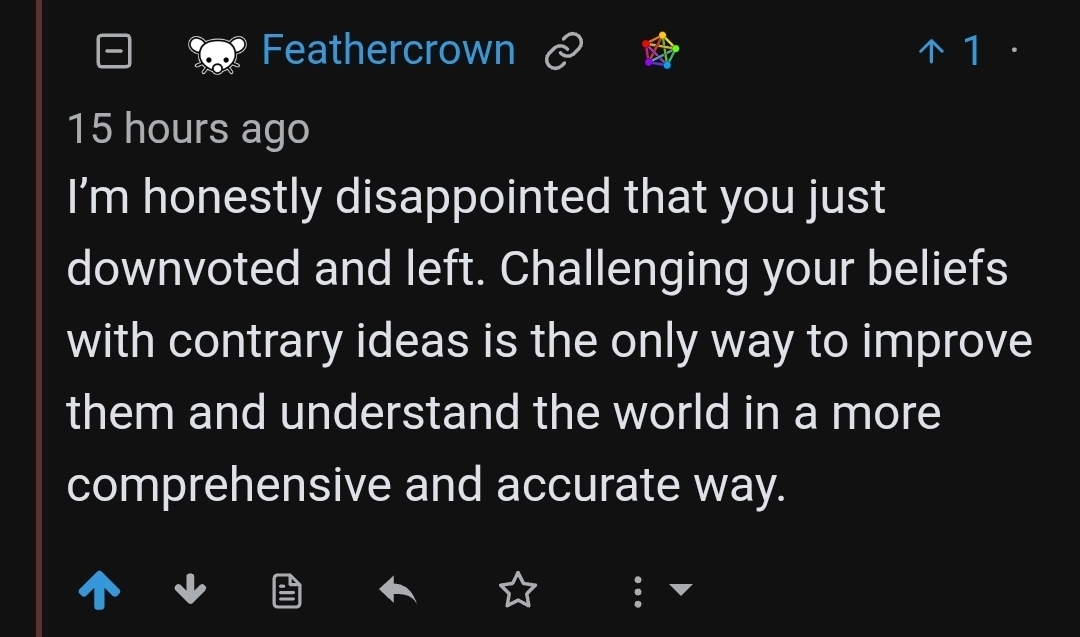
I'm honestly disappointed that you just downvoted and left. Challenging your beliefs with contrary ideas is the only way to improve them and understand the world in a more comprehensive and accurate way.

[–] Feathercrown@lemmy.world 3 points 2 days ago* (last edited 2 days ago) (7 children)

Uh, no. I don't think you've thought this through, or you're just using (AS) without realizing it. Conversations around operator precedence can cause real differences in how expressions are evaluated and if you think everyone else is just being pedantic or is confused then you might not underatand it yourself.

Take for example the expression 3-2+1.

With (AS), 3-2+1 = (3-2)+1 = 1+1 = 2. This is what you would expect, since we do generally agree to evaluate addition and subtraction with the same precedence left-to-right.

With SA, the evaluation is the same, and you get the same answer. No issue there for this expression.

But with AS, 3-2+1 = 3-(2+1) = 3-3 = 0. So evaluating addition with higher precedence rather than equal precedence yields a different answer.

=====

Some other pedantic notes you may find interesting:

There is no "correct answer" to an expression without defining the order of operations on that expression. Addition, subtraction, etc. are mathematical necessities that must work the way they do. But PE(MD)(AS) is something we made up; there is no actual reason why that must be the operator precedence rule we use, and this is what causes issues with communicating about these things. People don't realize that writing mathematical expressions out using operator symbols and applying PE(MD)(AS) to evaluate that expression is a choice, an arbitrary decision we made, rather than something fundamental like most everything else they were taught in math class. See also Reverse Polish Notation.

Your second example, -1+3+2=4, actually opens up an interesting can of worms. Is negation a different operation than subtraction? You can define it that way. Some people do this, with a smaller, slightly higher subtraction sign before a number indicating negation. Formal definitions sometimes do this too, because operators typically have a set number of arguments, so subtraction is a-b and negation is -c. This avoids issues with expressions starting with a negative number being technically invalid for a two-argument definition of subtraction. Alternatively, you can also define -1 as a single symbol that indicates negative one, not as a negation operation followed by a positive one. These distinctions are for the most part pedantic formalities, but without them you could argue that -1+3+2 evaluated with addition having a higher precedence than subtraction is -(1+3+2) = -6. Defining negation as a separate operation with higher precedence than addition or subtraction, or just saying it's subtraction and all subtraction has higher prexedence than addition, or saying that -1 is a single symbol, all instead give you your expected answer of 4. Isn't that interesting?

[–] Feathercrown@lemmy.world 1 points 2 days ago (9 children)

They do, it's grouping those operations to say that they have the same precedence. Without them it implies you always do addition before subtraction, for example.

[–] Feathercrown@lemmy.world 1 points 6 days ago (2 children)

A 10 hour video is too much imo. These people need to learn how to edit

[–] Feathercrown@lemmy.world 3 points 6 days ago

I love those videos. They've done more for safety awareness than any ad campaign ever will

[–] Feathercrown@lemmy.world 4 points 6 days ago

Tested got me through covid

view more: next β€Ί