Earth, Environment, and Geosciences

3043 readers
17 users here now

Welcome to c/EarthScience @ Mander.xyz!


Notice Board

This is a work in progress, please don't mind the mess.


What is geoscience?

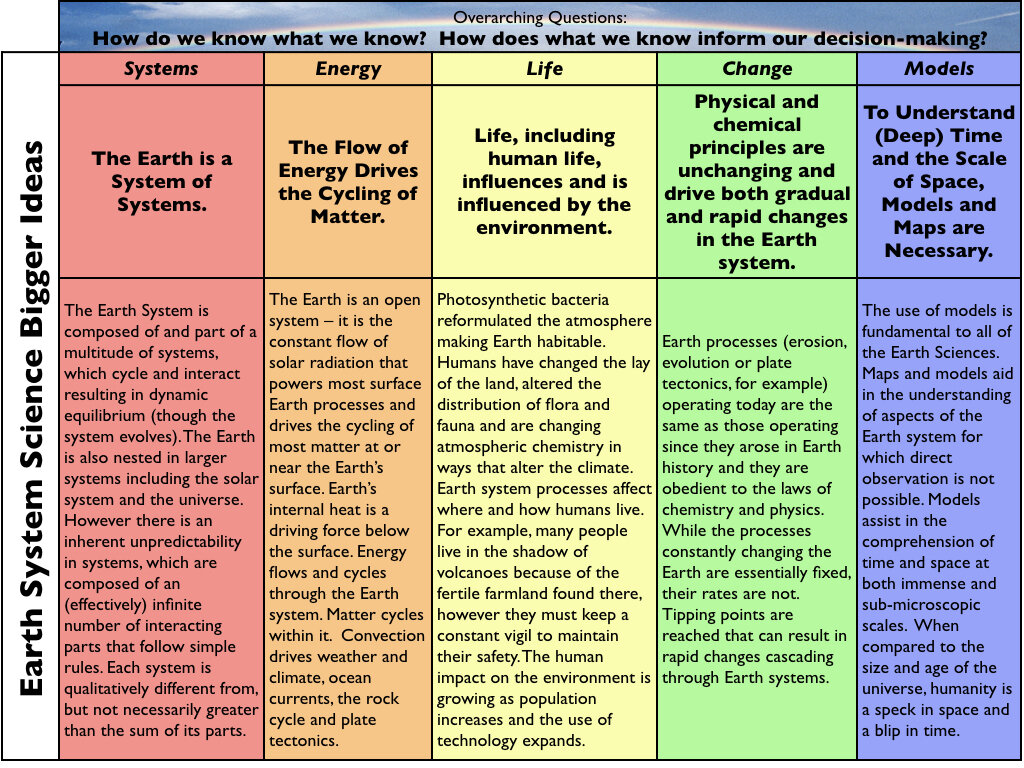
Geoscience (also called Earth Science) is the study of Earth. Geoscience includes so much more than rocks and volcanoes, it studies the processes that form and shape Earth's surface, the natural resources we use, and how water and ecosystems are interconnected. Geoscience uses tools and techniques from other science fields as well, such as chemistry, physics, biology, and math! Read more...

Quick Facts

Rules

  1. Don't throw mud. Be kind and remember the human.
  2. Keep it rooted (on topic).
  3. No spam.


Jobs

Teaching Resources

Tools

Climate


Similar Communities


Sister Communities

Science and Research

Biology and Life Sciences

Plants & Gardening

Physical Sciences

Humanities and Social Sciences

Memes

founded 2 years ago
MODERATORS
1
2
3


Please post any relevant links you would like to add to the resource collection on the sidebar! :) Eventually I will go through my bookmarks too! Any kind of tools, important websites or references are welcome.

4
5
6


...

A key component of the study [to be conducted in Romania] is the characterisation of low-conflict sites—areas with minimal risk to biodiversity and communities and which meet essential technical criteria for renewable energy development. These areas are broader than the RAAs defined in Directive (EU) 2023/2413, and while not all low-conflict sites will become RAAs, mapping them nationwide will support responsible renewable deployment both within and beyond designated acceleration zones.

...

Beyond identifying low-conflict areas for clean energy development, the study will serve as a dialogue platform bringing together national and local authorities, grid operators, energy associations, academia and civil society. This collaborative space will help address challenges, share perspectives and strengthen informed decision-making in shaping Romania’s renewable energy future.

...

7


cross-posted from: https://mander.xyz/post/43762657

  • The European Union plans to expand its Carbon Border Adjustment Mechanism to some assembled goods such as cars and washing machines to help close loopholes.
  • The EU introduced CBAM to safeguard its industry during an ambitious shift to net zero by 2050 and prompt other parts of the world to make their output greener.
  • The EU will propose measures to extend the levy to selected steel and aluminium-intensive downstream products, and will also unveil a proposal on how to support its own exporters via a new fund.

...

The European Union plans to expand an incoming emissions charge on imported goods as part of efforts to strengthen a flagship climate policy that’s aimed at protecting the bloc’s industries during the green shift.

The EU has pressed ahead with its Carbon Border Adjustment Mechanism — which covers six emissions-intensive sectors — despite criticism from trading partners from the US to China. On Wednesday, it plans to propose measures to extend the levy to some assembled goods such as cars and washing machines to help close loopholes, according to a draft.

...

The EU introduced CBAM to safeguard its industry during an ambitious shift to net zero by 2050 and prompt other parts of the world to make their output greener. The idea is that carbon-intensive sectors forced to comply with the bloc’s world-leading climate laws won’t face unfair competition from producers operating in nations with weaker rules. It comes amid concerns that Europe is deindustrializing under the strain of high energy prices and the green transition.

“The overall objective of the legislative proposal is to strengthen the effectiveness of CBAM, thus reducing greenhouse gas emissions and fighting climate change globally,” the EU says in the draft proposal, which is still subject to change. “This proposal will extend the scope of CBAM to selected steel and aluminium-intensive downstream products.”

...

As of January this year, dozens of carbon-trading systems were in force globally, covering almost a fifth of global emissions, according to a report by non-profit organization IETA. Under EU rules, the fee importers will need to pay could be at least partially waived if a carbon levy has already been paid in the country where the goods were produced.

“The CBAM is deeply unpopular among major exporters to the EU, but it has already proven to be effective in pushing reticent countries toward building or expanding carbon-pricing efforts,” said Henry Lush, a carbon analyst at consultants Veyt.

...

The European Commission on Wednesday will also unveil a proposal on how to support its own exporters via a new fund filled with a quarter of the proceeds collected from the levy over the next two years, according to a draft seen by Bloomberg. In addition, it will present detailed rules on calculating fees that importers will have to pay at the border, and measures to prevent circumvention.

The fees companies will have to pay will largely depend on the so-called default values, which will effectively set a price list for emissions when importers can’t provide verified, installation-specific data at the border, according to Robert Jeszke, head of Poland’s emissions management authority.

“In the early years, the most immediate behavioral effect is likely to be improved monitoring and verified reporting, rather than instant deep decarbonization across the board,” he said. “But CBAM’s financial materiality will rise over time.”

...

8
9


An atmospheric phenomenon occurring over much of California was unmistakable in satellite imagery in late autumn 2025. Fog stretching some 400 miles (640 kilometers) across the state's Central Valley appeared day after day for more than two weeks in late November and early December. Known as tule (TOO-lee) fog, named after a sedge that grows in the area's marshes, these low clouds tend to form in the valley in colder months when winds are light and soils are moist.

10
11


cross-posted from: https://lemmy.sdf.org/post/46910935

Archived

[...]

China’s dominance in the renewable energy supply chain—especially in rare earth minerals, copper and lithium processing—has led to massive industrial expansion in Tibet. While promoted internationally as sustainable climate action, many projects have instead resulted in water contamination, ecosystem collapse, cultural displacement, and intensified political repression.

“Under the guise of green energy development, Tibet is being reshaped to fuel China’s economic and geopolitical ambitions,” said Tempa Gyaltsen Zamlha, Deputy Director of the Tibet Policy Institute, in his welcome address. “These mines and mega-dams are marketed as climate-friendly, but they have devastated Tibet’s rivers, grasslands, wildlife habitats, and traditional communities.”

The Tibetan Plateau, often called the Third Pole, contains the world’s largest reserve of freshwater outside the polar regions. Its rivers support nearly 1.9 billion people across Asia. Yet, scientists have warned that the plateau is warming at nearly twice the global average, accelerating glacial melt and causing irreversible environmental instability.

[...]

12


cross-posted from: https://lemmy.sdf.org/post/46910756

Archived

The world’s biggest carbon polluter is expected to keep total emissions flat in 2025 despite rising energy demand – a sign that clean power may, for the first time, fully offset the growth in electricity consumption, the analysis by the Centre for Research on Energy and Clean Air (CREA) showed.

The country’s emissions only rose by 0.6% in 2024, a significantly slower pace of growth than the previous year, according to official Chinese government data published on Thursday.

But the Finland-based research group cautioned that a “concerning” policy environment for the next few years increased the risk of an emissions rebound. It added that China was also set to miss its key target for cutting carbon intensity – CO2 emissions per unit of gross domestic product – this year, meaning steeper reductions will be needed to hit its headline 2030 climate goal of slashing carbon intensity by 65%.

[...]

Record solar energy installations and strong growth in wind power capacity have increased the share of non-fossil fuel electricity this year, with emissions from the power sector set to decline for the first time since 2016, the report said. But that progress has been partially countered by the rapidly growing use of coal for the production of plastics and other chemical products, meaning overall emissions are expected to remain stable.

At the same time, experts have warned that China’s new pricing system for solar and wind projects risks slowing the clean energy boom. Under the new policy introduced last June, developers of new solar and wind power plants need to secure contracts with provincial authorities through competitive auctions, instead of being guaranteed a fixed price.

[...]

Coal power plants, on the other hand, are protected from this market-based system, relying instead on long-term power purchase agreements that lock in prices, Schäpe said, describing it as “unfair competition”.

China’s rapidly expanding coal power fleet is adding to the concerns. In 2025, the country has added the largest amount of coal-fired capacity since 2015, while progress on retiring older plants remains very slow, CREA’s report highlighted.

This runs contrary to a pledge made by President Xi Jinping in 2021 to “strictly control” new coal power projects. That commitment was omitted from Beijing’s updated national climate plan (NDC) submitted in late October ahead of COP30.

[...]

13


cross-posted from: https://mander.xyz/post/43026095

Web archive link

...

The carbon border tax, which comes into force from January, was behind an attempt by the big exporters to scupper wider negotiations on climate action at the latest UN summit in Brazil.

Speaking in the aftermath at COP30, Wopke Hoekstra told the Financial Times that the petrostates had also been “more assertive” across the board in a bid to thwart climate agreements as the shift to cleaner energy systems accelerates.

“Some of those making money out of [fossil fuels] are seeking to prolong that process. We have seen this quite explicitly,” he said. “Some of the petrostates are seeking to at least slow down rather than speed up [the energy transition].”

He added: “I have sensed a certain sense of assertiveness that might not have been there five or 10 years ago.”

...

During public and closed-door meetings at the two-week talks, some of the developing countries argued the tax, or carbon border adjustment mechanism (CBAM), was a unilateral measure that would drive up costs, restrict trade and hinder their ability to grow their economies.

The tax will initially apply to products such as steel, cement and fertilisers, and aims to ensure imported goods meet similar green standards to those produced inside the EU or face an additional charge.

...

Hoekstra said the criticism was “clearly not very credible”, adding that in one-on-one conversations many countries “acknowledge it is clearly a climate tool” rather than a trade measure.

...

More than 80 countries had rallied around a proposal at COP30 for a so-called road map to help countries wean their economies off fossil fuels. But the plan failed to appear in the final agreement after objection from more than 30 other countries [particularly China, Russia, and petro-states in the Middle East].

...

14


China's efforts to slow land degradation and climate change by planting trees and restoring grasslands have shifted water around the country in huge, unforeseen ways, new research shows.

15
16
17


Prof. Nick Zentner (Geology) at Washington State showing an accurate representation of the ice age floods that shaped a lot of the canyons we see today in NA.

18