Biodiversity

2958 readers
1 users here now

Welcome to c/Biodiversity @ Mander.xyz!

A community about the variety of life on Earth at all levels; including plants, animals, bacteria, and fungi.


Notice Board

This is a work in progress, please don't mind the mess.

2023-06-16: We invite our users to contribute resources for the sidebar.

2023-06-15: Looking for mods!


About

Biodiversity is a term used to describe the enormous variety of life on Earth. It can be used more specifically to refer to all of the species in one region or ecosystem. Biodiversity refers to every living thing, including plants, bacteria, animals, and humans. Scientists have estimated that there are around 8.7 million species of plants and animals in existence. However, only around 1.2 million species have been identified and described so far, most of which are insects. This means that millions of other organisms remain a complete mystery.

Over generations, all of the species that are currently alive today have evolved unique traits that make them distinct from other species. These differences are what scientists use to tell one species from another. Organisms that have evolved to be so different from one another that they can no longer reproduce with each other are considered different species. All organisms that can reproduce with each other fall into one species. Read more...

Rules

  1. Don't throw mud. Be kind and remember the human.
  2. Keep it rooted (on topic).
  3. No spam.


Quick Links

Resources


Bypass Paywalls


Similar Communities


Sister Communities

Science and Research

Biology and Life Sciences

Plants & Gardening

Physical Sciences

Humanities and Social Sciences

Memes


Find us on Reddit!

founded 2 years ago
MODERATORS
26


Gynandromorphs are rare organisms that are half-male and half-female, where each side of the body presents differently, split right down the middle. Gynandromorphs are distinct from hermaphrodites in that hermaphrodite organisms still have bilateral symmetry and naturally have both sex organs. Hermaphroditism is common in some organisms, while gynandromorphism is much rarer.

27


cross-posted from: https://hexbear.net/post/6420770

Less than two years after researchers at the University of Exeter in the United Kingdom warned that the world was nearing numerous climate tipping points, a report out Monday warns that one such “point of no return” has already been reached, with warm-water coral reefs “experiencing unprecedented dieback.”

Surging global temperatures, especially in recent years, have pushed the world’s coral reefs into a state of widespread decline, with the worst bleaching event on record taking place since 2023. More than 84% of the world’s reefs have been impacted.

In the Global Tipping Points Report 2025 released Monday, the researchers warned that “the central estimate” of coral reefs’ “tipping point of 1.2°C global warming has been crossed,” with planetary heating now at about 1.4°C above preindustrial levels.

The warming waters have caused widespread bleaching of coral reefs, which impacts the nearly a million species of marine animals and organisms that rely on them to support some of the planet’s most diverse ecosystems.

“Unless we return to global mean surface temperatures of 1.2°C (and eventually to at least 1°C) as fast as possible, we will not retain warm-water reefs on our planet at any meaningful scale,” the report says. Minimizing non-climatic stressors, particularly improved reef management, can give reefs the best chance of surviving under what must be a minimal exceedance of their thermal tipping point.“

The decline of coral reefs also leaves coastal communities without natural barriers against storm surge, compounds the overfishing crisis by depriving fish of a habitat in which to reproduce, and impacts thousands of jobs and billions of dollars in reef tourism each year.

”As we head into the COP30 climate negotiations it’s vital that all parties grasp the gravity of the situation.“

”We can no longer talk about tipping points as a future risk,“ Steve Smith, a social scientist at the University of Exeter and a lead author of the report, told Nature. ”This is our new reality.“

Full Article

28
29


It’s official: the only Australian shrew is no more.

The latest edition of the International Union for the Conservation of Nature’s Red List, the world’s most comprehensive global inventory on extinction risk, has declared the Christmas Island shrew is extinct.

Shrews are small, long-nosed, insect-eating mammals, with many species widely distributed across Asia, Africa, Europe and the Americas. On mainland Australia, similar roles are filled by unrelated small marsupials such as dunnarts, antechinuses, planigales and ningauis, which are themselves not writ large on our national consciousness.

30


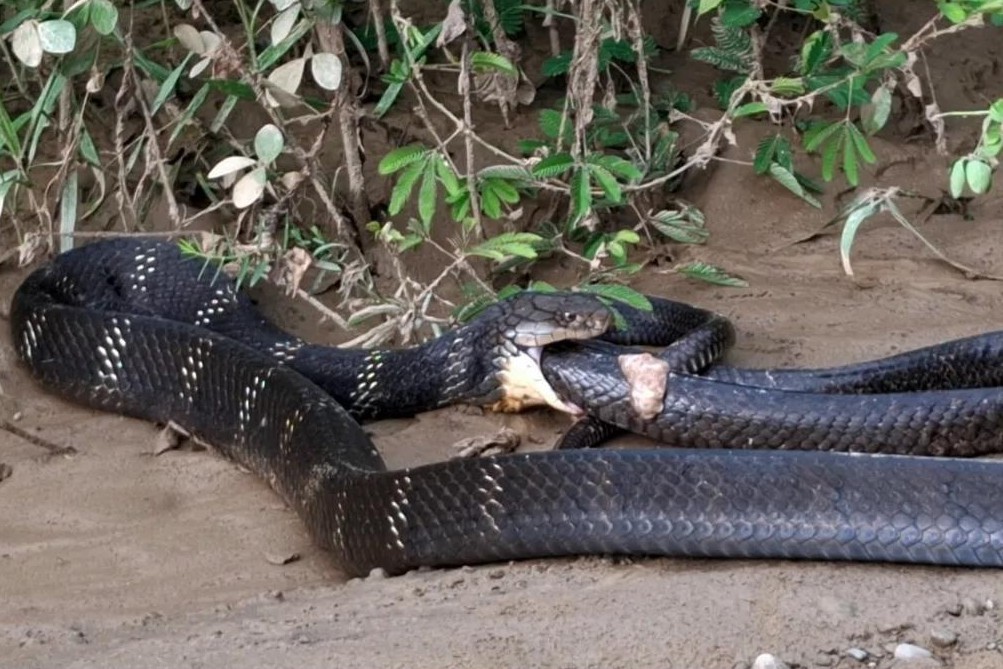
This king cobra was found in the midst of a well populated village and was promptly rescued by a team of professional snake handlers who afterwards safely released the snake into a nearby forested area away from any habitation. When threatened or stressed after immediately consuming a large meal, reptiles, particularly snakes will sometimes regurgitate the contents in their stomachs to lighten themselves to be able to make a quick getaway or defend themselves. King cobras are ophiophagous, with their diet consisting mainly of other snake species including several nonvenomous and venomous snake species, including other king cobras. This one was in the process of regurgitating a ratsnake that it had consumed.

PS. This is for educational purposes only. I cannot stress enough on the fact that you must never attempt to handle wildlife or try to relocate a snake (especially venomous ones) by yourself unless you are a trained professional or rescuer with proper equipment and training to deal with them, as not only is it very stupid and dangerous for both yourself and for the animal involved but it can very well result in grevious injury or death for the people around and for the snake.
31


substack-acfbf568-6be2-4f5f-a198-4587ef2ca0ae

32


There are some 2,700 wolves across Idaho, Montana and Wyoming, and seemingly just as many opinions about how they should be managed.

In August, a federal judge from the U.S. District Court in Montana added one more to the mix when he ordered the U.S. Fish and Wildlife Service (USFWS) to revisit its 2024 decision to keep Northern Rocky Mountain gray wolves off the federal endangered species list and under the management of those three states.

Among other missteps, the agency had not incorporated “the best available science” into its decision, Judge Donald Molloy wrote. His decision has come at a precarious time for the Endangered Species Act: The USFWS is considering revoking key protections for habitat critical to endangered species, and a handful of proposed bills before Congress would remove protections from certain animals, bypassing the agency.

The ruling is just the latest chapter in a saga that’s stretched on since 1995 over whether wolves across different regions of the lower 48 states should be listed—what Molloy calls a “political yo-yo process.” Scientists say this constant volleying could have profound consequences for wolves in the contiguous U.S., undermining the decades of work that conservationists and governments have done to bring them back from the brink. Gray wolves are still listed as endangered or threatened in the majority of states.

33


cross-posted from: https://hexbear.net/post/6277945

A trio of First Nations researchers is blending traditional knowledge and science to map whale migration and advocate for improved conservation.

On the NSW Central Coast's craggy headlands, you hear the gasp before you spot the splash. Whether it's a spout of air, a whip of a tail or a magnificent full-body breach, whale migration season stirs a ripple of excitement among the binocular-braced onlookers at Norah Head.

Dr Chels Marshall is standing among them on a makeshift stage, addressing the crowd, which has gathered to celebrate the importance of whales in Indigenous culture.

Marshall, a Gumbaynggirr woman and ecologist, recounts a Dreaming story traditional to her Country on NSW's Mid North Coast. It’s about two koala brothers who become stranded when the sea rises around them. Luckily, a humpback whale comes to their rescue and helps them return safely to land.

"It's that whale that comes along every year, bringing joyfulness, peace and people together, like today," she explains.

Whales hold sacred status in many Indigenous communities, in stories, songlines and rock art. But that cultural significance does not guarantee legal protection – especially as their migration pathways come under threat.

Full Article

34
35
36


cross-posted from: https://hexbear.net/post/6227847

Underwater noise is a serious threat to endangered southern resident killer whales, as shipping traffic intensifies through some of the busiest waters off “Vancouver Island.”

Indigenous-led efforts are underway to track vessel noise and protect whale habitat, according to government documents obtained by Canada’s National Observer, as maritime traffic in the area surges following the expansion of the Trans Mountain pipeline. It’s expected to grow even more with a port expansion south of “Vancouver,” too.

Snuneywuxw First Nation, whose traditional territory includes the “Gulf Islands” and key fishing grounds along major shipping routes between “Nanaimo” and “Vancouver,” is now in its second year of monitoring underwater noise.

“We’re seeing extreme impacts,” said John White, member of the First Nation and its director of land and natural resources. He said vessel traffic, particularly in “Nanaimo’s” harbour and the “Northumberland Channel,” generates underwater noise that has not been previously well-studied.

“[Noise] ranges jump off the charts when we see all these vessels coming through.”

The First Nation’s field teams collect acoustic data in a five-kilometre stretch between “Nanaimo” and “Gabriola Island,” waters regularly crossed by BC Ferries and congested with freighters waiting for a berth in “Vancouver.”

Full Article

37
 
 
38
1
submitted 2 months ago* (last edited 2 months ago) by solo@slrpnk.net to c/biodiversity@mander.xyz


Biologists at The University of Texas at Austin, who have reported discovering a bird that's the natural result of a green jay and a blue jay's mating, say it may be among the first examples of a hybrid animal that exists because of recent changing patterns in the climate. The two different parent species are separated by 7 million years of evolution, and their ranges didn't overlap as recently as a few decades ago.

39
 
 
  • California’s native jewelflowers, a group of plants that belong to the mustard family, grow in widely diverse landscapes and microclimates across the state. But until now, scientists didn’t understand what allowed their wide distribution.
  • To understand this, researchers analyzed information from nearly 2,000 specimens; dug into climate and geological databases; and amassed field observations to understand the climatic conditions that 14 species of jewelflowers need to grow and reproduce.
  • Their study found that, despite living in different landscapes, from desert to valleys and mountains, jewelflowers prefer hotter and drier climates, timing their sprouting and flowering accordingly. Even those species growing in colder regions adjust their life cycle to flower later in the summer and seek drought-prone soils.
  • The research shows how plants distributed across vast geographies may require specific microclimates and habitats to survive, which are potentially at risk in a warming world.

archived (Wayback Machine)

40


On a tiny Italian island, scientists conducted a radical experiment to see if the bees were causing their wild cousins to decline.

Off the coast of Tuscany is a tiny island in the shape of a crescent moon. An hour from mainland Italy, Giannutri has just two beaches for boats to dock. In summer, hundreds of tourists flock there, hiking to the red and white lighthouse on its southern tip before diving into the clear waters. In winter, its population dwindles to 10. The island’s rocky ridges are coated with thickets of rosemary and juniper, and in warmer months the air is sweetened by flowers and the gentle hum of bees.

“Residents are people who like fishing, or being alone, or who have retired. Everyone has their story,” says Leonardo Dapporto, associate professor at the University of Florence.

It was Giannutri’s isolation that drew scientists here. They were seeking a unique open-air laboratory to answer a question that has long intrigued ecologists: could honeybees be causing their wild bee cousins to decline?

To answer this, they carried out a radical experiment. While Giannutri is too far from the mainland for honeybees to fly to it, 18 hives were set up on the island in 2018: a relatively contained, recently established population. Researchers got permission to shut the hives down, effectively removing most honeybees from the island.

When the study began, the island’s human population temporarily doubled in size, as teams of scientists fanned out across the scrubland tracking bees. Then came the ban: they closed hives on selected days during the peak foraging period, keeping the honeybees in their hives for 11 hours a day. Local people were sceptical. “For them, we were doing silly and useless things,” says Dapporto. But the results were compelling.

“‘Wow,’ was my first response,” says the lead researcher, Lorenzo Pasquali, from the University of Florence. When the data came together, “all the results were pointing in the same direction”.

https://archive.is/H9Gy6

41


cross-posted from: https://hexbear.net/post/6124538

cross-posted from: https://ibbit.at/post/51800

DUNOY, Philippines — In the dense, tropical rainforests of the Northern Sierra Madre Natural Park, an ancient predator drifts silently beneath the surface of still rivers. For Indigenous Agta elders, this reptile is not a menace, but a guardian. “We have always coexisted peacefully with crocodiles, and today I am passing on to my grandchildren the same advice my parents gave me,” says Olalia Infiel, an Agta elder of Dunoy. “I often encountered crocodiles while washing clothes or bathing in the river. My parents always told me to speak to the crocodiles first and ask for their permission to share the same space.” The Philippine crocodile (Crocodylus mindorensis), a severely threatened crocodile species, is staging a slow but hopeful comeback in the wild, thanks to an alliance between science, tradition and community-led conservation. Once widespread across the Philippine archipelago, the species is listed as critically endangered by the International Union for the Conservation of Nature (IUCN). Fewer than 250 individuals survive in the wild today, local conservationists say, and most are confined to these rivers and wetlands of northeast Luzon. According to local conservationists, the Philippine crocodile’s survival in recent decades is highlighting how Indigenous knowledge, when integrated with conservation science, can support efforts to protect even the most endangered species. In the mythology and folklore of Indigenous peoples such as the Agta, crocodiles play a prominent role. In many cases, crocodiles are regarded as the embodiment of benevolent ancestors, known as anito, who are venerated as personal guardians and…This article was originally published on Mongabay


From Conservation news via this RSS feed

42


The Atlas blue butterfly is found in the mountain ranges of Morocco and northeast Algeria.

While it had been suspected to have the most chromosome pairs in the animal kingdom, this is the first time experts have sequenced the butterfly genome to confirm.

For comparison, a close relative found widely in the UK, the common blue butterfly (Polyommatus icarus), has 24 chromosomes.

Changes in chromosome numbers are thought to contribute to the process of new species forming and help species adapt to their environment.

43


All eight arms of an octopus can be used for whatever their cephalopod owner wishes, but some arms are favored for certain tasks.

A new, detailed analysis of how octopuses wield their famously flexible appendages suggests that all eight arms share a skill set, but the front four spend more time on exploration and the back four on movement. The findings, published September 11 in Scientific Reports, provide a comprehensive accounting of how subtle arm movements coordinate the clever invertebrates’ repertoire of behaviors.

44
 
 
45


MBARI's advanced underwater technology is revealing the remarkable species that thrive in the deep sea. In 2019, MBARI researchers encountered an unfamiliar pink snailfish swimming just above the seafloor. New research from MBARI collaborators has confirmed this individual represents a species previously unknown to science: the bumpy snailfish (Careproctus colliculi).

A team of researchers from the State University of New York at Geneseo (SUNY Geneseo), with scientists from the University of Montana and the University of Hawaiʻi at Mānoa, published their findings in the journal Ichthyology and Herpetology, describing the bumpy snailfish observed by MBARI researchers alongside two other snailfishes from the abyssal seafloor offshore of California.

46
 
 
  • Researchers developed a cost-effective way to collect DNA from species high in the rainforest canopy: they hung umbrellas to collect rainwater that washed through the trees.
  • The method revealed 562 species across French Guiana’s Amazonian forests, capturing genetic signatures from elusive nocturnal mammals, poorly documented reptiles, and countless undescribed insects that traditional survey techniques consistently overlook.
  • Comparative analysis showed old-growth forests harbored 1.3 to 1.9 times greater species diversity than in nearby managed plantations.
  • This simple technique provides local communities and conservationists with a practical way to monitor their forests, as each raindrop carries genetic evidence of the species present in the area over time.

archived (Wayback Machine)

47
48


Iberian Harvester Ants, Messor ibericus, can produce offspring of two different species, according to a new Nature study. Messor ibericus queens can produce males of Messor structor in addition to their own species. This bizarre observation is at odds with how scientists conventionally think about species, so it may prompt a rethink of these already blurry definitions.

The paper: One mother for two species via obligate cross-species cloning in ants

49
50
view more: ‹ prev next ›